Monday, March 28, 2016

The Cushioning of Daily Life

Digby describes the standard furnishing arrangements of Elizabethan quarters as being relatively sparse by today's standards, suggesting that "There were splendid tapestries on the walls, imposing chimney-pieces, and often friezes and ceilings of elaborate plaster work, but in the rooms there was little furniture" (1963:108). Tables were relatively few --  generally the smaller trestle tables outfitted a room, as well as "the occasional cupboard", but most household belongings were stored in coffers and boxes (Digby 1963:108). Most astutely, Digby points out that "the sitting accommodation would strike us as inadequate and uncomfortable" (1963:108). Chairs were very few, reserved for the highest ranking personage in the room -- usually the Mistress or Master of the house, or guests of distinguishment (Digby 1963). All others were expected to perch on stools, and


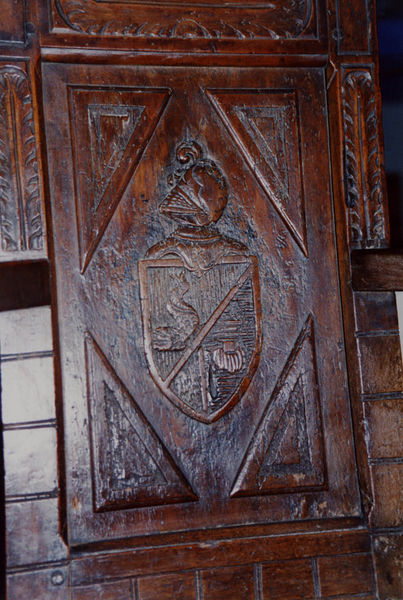
A French box chair dated to 1515, combining comfort and utility! Walnut with oak.
The coat of arms is suspected to have been added long after the manufacture of the chair (maybe to help make it look even more antiquey).
Image courtesy of the Victoria and Albert Museum


 "this accounts for the extraordinary importance of cushions in Elizabethan houses. Cushions made the hard un-upholstered furniture more comfortable; the rich materials and embroideries used as cushion covers were in keeping with the splendid costumes worn by Elizabethans and they also added a generous note to the interior of the rooms." (Diby 1963:108)


An oak stool of British origin dating between 1600-1625. It's only 57 cm tall -- look how cute it is! 
Image courtesy of the Victoria and Albert Museum.

In his travels to Windsor Castle in 1598, Paul Hentzner commented on "'a cushion most curiously wrought by Queen Elizabeth's own hands'", and cushions were another item commonly among the New Years gifts the Queen was customarily granted (Digby 1963:108). They were typically produced in two varieties, long and square, with long being the more common owing to the typical loom width of 20" or 22" (Digby 1963).


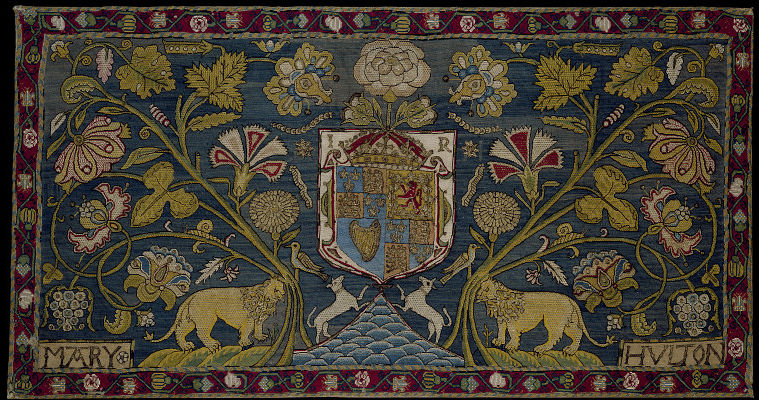
 Despite the fact that the Royal Arms have been worked on this British cushion, little is known about it. It is dated between 1603-1625, but the identity of Mary Hulton remains a mystery. 
Linen canvas embroidered in silk, wool, and gilt thread, primarily in tent stitch and long-armed cross stitch, with some plaited work. 
Image courtesy of the Victoria and Albert Museum.


Cushions, which were often produced both domestically and professionally, have been preserved in large numbers at Hardwick Hall (Digby 1963). Household inventories drawn up in the year of 1601 even allow for the historical reconstruction of the placement of these pillows in the household (Digby 1963). They appear to come in a seemingly endless variety including the narrative and mythological scenes, such as the cushion (one of a complementary pair described in the inventory) featuring the kidnap of Europa by the bull Zeus which was kept in what was officially known as the Best Bed-chamber (Diby 1963). But they also appear to be a popular site for armorial ornamentation.


British cushion dating to 1540 showing the arms of John Warneford impaling those of his wife Susanna, daughter of John Yates. Digby identifies this as a professionally made cushion based on its skillful execution and replication of "the type of verdure tapestry with enormous fronds and leaves,with frogs and insects peering from amongst them, which was so popular on the walls of the mid-sixteenth century houses of England" (1963:109).
Linen canvas embroidered with silk in tent stitch.
Image courtesy of the Victoria and Albert Museum. 

These scenes of Europa are almost certain to have been executed by Elizabeth Shewsbury (aka Bess of Hardwick), given that they bear her initials. Mary Queen of Scots also produced cushions retained at Hardwick, two square cushions to be precise, but they are not accounted for in the Hardwick inventory (Digby 1963), likely indicating that these were understood to be the personal belongings of she who worked them. One of the cushions prominently reflects Mary's mixed allegiances and her claim to many thrones, showing a rose, a lily, and a thistle, the emblems of England, France, and Scotland respectively (Digby 1963).These flowers are fitted within a framing device consisting of interlocking lozenges, while the four corners of the cushion and its centre feature emblems enclosed in roundels (Digby 1963). Chief among these, at the cushion's heart, is Mary's cipher, while the peripheral emblems were taken from Gabriel Faerno's emblem book Fables (1563) (Digby 1963, Swain 1986).


Cushion worked by Mary Queen of Scots. 
Yellow silk ground with silk and gilt thread worked in tent stitch and plaited braid stitch.
Image courtesy of Digby 1963:114-115.

Digby points out the social and intellectual function of these compositional choices, given that the devices seen on these cushions "would have served as an intellectual puzzle on which courtiers could have exercised their wit and learning" (Digby 1963:115). While the busyness of this work may detract from its overall aesthetic refinement, according to Digby, "Mary's cushions are expertly done with the finest materials, but her wish to exercise her wit and her learning and her personal use of her royal badges triumph over the purity of the design, although they give an element of interest and individuality that is entirely right for a noble-born needlewoman, who is a queen" (Digby 1963:116).This cushion is also an encouraging find because it demonstrates an instance in which silks were embroidered directly for the production of cushions; although the majority of the surviving cushions from this era appear to be made of canvas or canvas applique on a different ground, this was not universally the case. Perhaps canvas and canvas applique is simply overrepresented in the historical record because of its durability.


My arm chair, replete with long cushion ripe for refurbishment 
(I am not overmuch fond of the purple).

The object that I intend to make differs from these cushions substantially, in that it is something of an ornamental -- rather than functional -- pillow. However, I have three cushions to recover according to my own furnishing schemes -- two long and one square, and I have not as yet decided which shall furnish the arm chair of my boudoir, and which shall bedeck the bed -- whichever I decide, I shall be sure to make note of it in the inventory.


Sources Cited


Digby, George Wingfield
1963 Elizabethan Embroidery. London, England: Faber and Faber.


Swain, Margaret
1986 Needlework of Mary Queen of Scots. Ramsbury, Great Britain: Ruth Bean Publishers.

Sunday, March 27, 2016

The State Bed

Let us now consider, in all its opulence and refinement, the state bed. Swain describes how “Of all the articles of furniture, beds were the most important during the sixteenth and seventeenth centuries” (1970:23). Reflecting its importance, beds and their trappings are usually listed first in household inventories (Swain 1970). In the best houses, Elizabethan beds were furnished with cloth of gold, cloth of silver, velvet, or silk damask, and often embellished with applique embroidery and lace fringes  (Digby 1963). Households of lesser means usually employed woollen cloth or linen, “often ‘passemented’ or trimmed with braid and fringes”  (Digby 1963:118) in emulation of other adornment. Expanding on her earlier point, Swain writes, “The state bed, for royalty or nobility, must have been an imposing affair with sumptuous hangings, a suitable stage for birth and death, and the furnishings, the tester and valances, the curtains, coverings, mattress and bolster, are often described in surprising detail” (Swain 1970:23). Digby concurs, adding that “the furnishing of a bed in one of the state rooms of a great house was often the most expensive part of the furniture, as inventories and accounts show” (Digby 1963:118). During his travels, Paul Hentzner wrote of having seen at Windsor Castle the beds which rested Henry VII, Henry VIII, Anne Boleyn, and Edward VI measuring at 11 square feet “‘and covered with quilts shining with gold and silver; Queen Elizabeth’s bed, with curious coverings of embroidery, but not quite so long and large..’”  (Digby 1963:118). Certainly, we can be grateful for any written description history entails, since many aspects of these beds fail to endure the weathering of time. 


The Blue Bed made for Christian Cavendish (1595-1675) at Hardwick Hall. 
The tapestries in the background depict the gods and planets.
Photograph by Nadia McKenzie. Image courtesy of the National Trust. 

Luckily, of the beds which saw to the comfort of Mary Queen of Scots and her retinue, much has been written. In a 1561 inventory, the listed items include a staggering eleven "'Beddis maid in Broderie'" (Swain 1970:24), nearly all outfitted with velvet, cloth of gold, or a combination of gold and silver, and two featured a ground of multicoloured satin (Digby 1963). Included in this inventory was one set of pands (a set of valances only), which are described as being embroidered with phoenixes of gold and falling tears, visual allusions to her mother Mary of Guise and her mother-in-law Catherine de Medici, whose impresas featured these motifs (Swain 1970). Additionally, the inventory lists three "'passmentit beds'", indicating that the trimmings of these bed furnishings had been ornamented with braid, or gold or silver lace (Swain 1970:23-24). There were also five "'plain beds of taffetas, velvet and damask'" and eleven "'auld Beddis'" adorned with salvaged pieces of tapestry, or sewed with silk on a worsted wool ground (Swain 1970:23-24). Of all the beds listed, only these humble beds featured any wool to speak of (Digby 1963). 

The bedroom of Mary Queen of Scots during the years of her freedom, Holyrood House. 

Some of these beds were even informally named by way of description; there was, of course, the Bed of Amitie, for which an order was issued in October of 1566 calling for 12 ells of violet taffeta for the making of the bedcover (Swain 1970). Among Mary's belongings, there was also a bed of crimson velvet “enriched with love knots"  and the embellished Roman numerals II, perhaps in reference to her first husband Francis II, as well as a bed “‘maid in broderie work of gold of the historie of the Workis of Hercules’” (Swain 1970:24). The latter of these two beds was housed at Hampton Court (Swain 1970). One bed, likely from Linlithgow, sported an embroidered curtain in black velvet applique and outlined using yellow silk cord, worked over in silk thread using satin stitch on a red woollen cloth ground  (Digby 1963). This curtain showed a bold pattern depicting pineapples, carnations, and “tree-like sprays of flowers spring[ing] from the backs of lions”  (Digby 1963:119). Then there is, of course, the legendary bed described by William Drummond of Hawthornden in his 1619 letter to Ben Jonson, a bed believed to be owned by the late Queen Mary and embroidered all over with gold and silk, showing the impresas of her self, her mother, King Henry II of France, Henry's successor and her husband King Francis II, her uncle the Cardinal of Lorraine, her other uncle King Henry VIII, the Duke of Savoy (as to which one, the letter does not say), and countless other impresas and emblems (Digby 1963)


The Mary Queen of Scots Room at Hardwick Hall (note: it is almost entirely certain that this erroneously named room never housed Mary Queen of Scots).
Photograph by Nick Guttridge. Image courtesy of the National Trust. 

 Additionally, there are a number of beds (or bed fragments, as the case may be) surviving at Hardwick Hall, where Mary spent part of her period of prolonged captivity (Swain 1970). One surviving set of bed furnishings, “‘imbroidered with needlework flowares’” on canvas worked during the 16th century, was remounted on black velvet in the 19th century (Black and Kaye 1986:89) for the sake of preservation. A second set shows canvas work dated to the 1620s, remounted on a 19th century ground of blue damask (Black and Kaye 1986). 

Image courtesy of France Voyage. 

Following the death of her husband, Catherine de Medici had made up a mourning bed (Lefebure 1888). It is described in written accounts penned after her death in 1589 as “‘a bed of black velvet, embroidered with pearls, powdered with crescents and suns, a foot-board, and head-board, nine valances, a coverlet of state similarly bedecked with crescents and suns, three damask curtains, with leafy wreaths and garlands figured upon a gold-and-silver ground, and fringed along the edges with broderies of pearls'” (Lefebure 1888:132). These crescents are likely a reference to the impresa of her dearly departed husband, King Henry II, who took as his visual signifier the crescent moon (Digby 1963). This is an action that boggles the modern mind; we think of the marital bed, but this seems quite the opposite. Who sleeps in the mourning bed, the mourner? Or is it left empty in memory of the departed? 


The bedroom of Diane de Poitiers at the Chateau de Chenonceau.. 
Image courtesy of France Voyage. 

All in all, what did these bed furnishings include? Indeed, there were the curtains, which were practically necessitated by a cold environment (Swain 1970). Four poster beds retained their use in Scotland and Northern England well into the 19th century (Swain 1970)
.

Ireton Bed at Packwood House, featuring 17th century needlework on the bed curtains, coverlet, cushions and stools. 
Photo by Keith Hewitt. Image courtesy of the National Trust.

Above the curtains, there were the valances, which hang around the three exposed sides of the roof of the bed (Swain 1970). Valances, which could be contiguous, were usually divided into three pieces that vary in size in accordance with the dimensions of the bed (Digby 1963). Valances are generally better preserved than curtains, since they were lined and they were spared the wear and tear of frequent use (Swain 1970). In some cases, valances were made to match the coverlet and headboard (Digby 1963), although since they were enduring, they could be carried over (as the pands in Mary's inventories show). Digby points out that “as these valances hung fairly rigidly they formed a frieze which was particularly suitable for embroidery with figure subjects” (1963:134). According to Swain, valances from Scotland in the 16th century can be categorized according to three thematic trends (1970). There were Biblical scenes, designs which featured a tree with a heraldic animal at the base, and the final category showing mythological scenes and Genre scenes depicting courtiers attired in French costume (Swain 1970). This last fashion, particularly the francophile proclivity, was likely introduced by Mary (Digby 1963). Often these figures have been worked into hunting scenes and other idyllic renditions of rural life (Digby 1963). Of the mythological scenes, Ovid's Metamorphoses was a particularly popular source of inspiration (Digby 1963).


Late 16th century English valance, wool and silk embroidered on canvas. Courtiers and religious figures.
Image courtesy of the Metropolitan Museum of Art. 

These valances appear to have been worked in a variety of stitches, which seems reasonable given that they were lined (which would not necessitate the reversible aesthetic of a curtain, which might be seen from both sides) and durable. As a personal observation, it appears as though tent stitch (especially on canvas) was a popular choice for objects which would see daily use, such as cushions, while a greater variety of stitches is exhibited in objects with better preservation and gentler handling, such as caskets -- the bedspread being a possible exception.


Late 16th century Scottish or British valance depicting Adam and Eve. 
Canvas ground with silk, wool, and gilt thread worked in chain, tent, split, and straight stitched with an applied gold braid.
Image courtesy of the Metropolitan Museum of Art. 

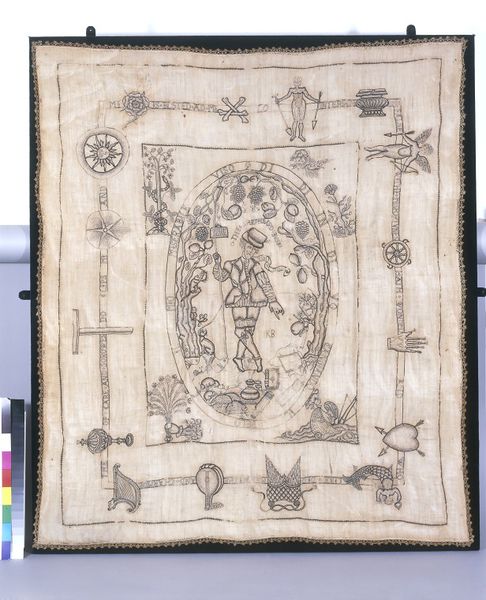
The bedspread was known as a coverlet. Few Elizabethan bed coverlets have survived, but they usually matched other bed hangings, and like these, they often wore out through continual use  (Digby 1963). For example, of the Hardwick furnishings, two small segments of a few bed coverlets survive, showing a similar design and employing "contiguous compartments set with floral motifs" with each fragment sporting a different border (Digby 1963:104). These coverlets were apparently multiuse objects, since some were used as hangings; the Hardwick inventory lists under the belongings of “'My Ladie’s Bed Chamber'” “‘a coverlett to hang before a dore… thre coverlets to hang before a windowe… a counterpoynt of tapestrie before an other dore’”  (Digby 1963:106), so the applications of a coverlet or tapestry were really quite varied, being put to many uses and salvaged for use on  other objects. A fine example of a coverlet can be seen in the enigmatic Shepherd's Buss, featuring its many “emblems and rebus devices”  (Digby 1963:105). Digby, who considers it a possible contender for a bedcover of unusual dimensions, points out that “the subject of the design is tantalizing and still has not been satisfactorily explained”  (Digby 1963:105). It bears the initials K.B., which has been attributed to Kalendrier des Bergers  by Guy Marchant (Digby 1963), but its authorship is also more or less unknown. The central scene of this incredible piece is enclosed within an oval sincribed with the phrase “Di di in di vo cangiando il pelo e il mio miserabile viso"  (Digby 1963:106), which apparently from Italian makes some reference to misery and changes of appearance. In the spandrels outside of this oval framing device are four emblems taken from Paradin’s emblem book Les Devices Heroqiues  (Digby 1963). Otherwise, this well preserved specimen is  a complete mystery.


The Shepherd Buss (1570-1600), linen embroidered in black silk, trimmed with bobbin lace.
Image courtesy of the Victoria and Albert Museum.

Pillows were covered in either plain or embroidered pillow beres, which were commonly among the proffered gifts granted the Queen on News Year’s day, and frequently were ornamented with silk on white linen (Digby 1963). Although these pillow beres bore similar dimensions to Elizabethan cushions (an average of 40" by 20" or 22"), they were distinct from cushions in that they often lacked a border (Digby 1963). Additionally, they provided a suitable medium for display of the famous Elizabethan blackwork (Digby 1963). Fun fact: in 1602, at Durham House in London, in the dead of night on April 1st, “'Thomas Nicholls yeoman and John Moore Taylor alias John West yeoman, both late of London, broke burglariously into the dwelling-house of Sir Walter Raleighe knight in the said parish, and stole therefrom two linen pillowbeeres… fitted with silke and golde worth £10, a linen cushinge cloth adorned with silk and gold worth £5…’”  (Digby 1963:130). I assume it was not taken from the bed in which he slept, unless -- hilariously -- it was, in which case (no pun intended) I assume he woke up yelling, "Curse you Thomas Nicholls and John Moore Taylor alis John West, yeoman, respectively!"


English pillow cover dating to 1592. Linen embroidered with silk and gilt thread, commemorating the marriage of Bernard Grenville and Elizabeth Beville. 

So how was the accomplished needlewoman to outfit such a richly bedecked bed? Well, of course, there were professionals, but Swain answers the tedium with variety. Variety in colours and in stitching, and “This love of variety for its own sake, in colours, or in stitches ... is characteristic of all domestic embroidery in Britain, as if the needlewoman were obliged to relieve the tedium of working a large piece by trying the effect of a new colour combination, or a new stitch” (Swain 1970:38). Readily can I attest to this, since the only thing that seems to bolster my perseverance when working a piece as large as mine. Having lately shaded in the majority of the hippocamp's body, and tiring of the endless array of short and long stitch -- which requires no small amount of mental input, since I must carefully consider both the angle of the stitch to work a contour as well as the uniform length and spacing of each stitch, I have returned to couching the waves. Since couching requires no especial concentration, as I am now simply in-filling large pre-determined segments, it makes for a nice reprieve.


Sources Cited


Black, David, and Raymond Kaye, eds.
1986 The Royal School of  Needlework Book of Needlework and Embroidery. London, England: The Oregon Press.

Digby, George Wingfield
1963 Elizabethan Embroidery. London, England: Faber and Faber.

Lefebure, Ernest
1888 Embroidery and Lace: Their Manufacture and History from the Remotest Antiquity to the Present Day: A Handbook for Amateurs, Collectors, and General Readers. Alan Cole, trans. London, England: H. Grebel and Co.


Thursday, March 24, 2016

The Cognitive Work of Embroidery

Consider this post something of a progress report and a rumination on the nature of needlework. In line with Rudolf Arnheim's analysis of children's drawings, I propose that conducting needlework cultivates visual intelligence by a number of mechanisms, namely a close observation of nature and the translation of three dimensional perceptual experience into the two dimensional plane. These two ideas are closely interrelated, so allow me to reverse the order of things and begin with the latter as my subject.


First, we must consider the properties of stitching, for this is the tool kit with which we render our subject. Of course, my composition is comprised almost exclusively of curved lines. According to my vision, the image will be enclosed by a roundel, and this framing device will feature a key at the top and bottom in which my motto will be enclosed. The text and the rectangular box that frames it represent the only linear aspects of my composition. The outer border of this rondel, in the long run, will be comprised of gold seed beads, which will provide a raised edge with a thick definition as well as a tactile component (following Lefebure's advice, since this fabric is very thin, and could quickly become warped and choked by the beads).


But the entirety of the interior portion filling out this rondel is round. The contours of the horse's muscles and coiled tail, the rolling waves, and the moon (which I intend to embroider in the void area behind the horse's shoulder in accordance with the Elizabethan compositional principle of "leave no space left uncovered") are all made up of curves. All of this is well and good -- except stitches are laid flat, and space is filled through the arrangement of short stacks of straight lines.


Imagine that each stitch is a brick, and with the bricks you wish to create a structure made in the round. Of course, there are a number of strategies by which we can achieve this. We can make an arch by fanning out the bricks, side by side. We can also lay bricks end to end on the diagonal. But whether we lay the bricks horizontally, vertically, or diagonally, these are the basic orientations with which they can be laid -- without deviation.


Next, we must examine the physical properties of our depiction, and apply these principles accordingly. Shading the waves was fairly easy to do, I just laid a horizontal gradient of colours through applied logic. The raised satin stitch was made less in imitation of nature, and more with the textural quality unique to embroidery in mind. But the hippocamp required a close observation of nature, especially to imagine the way in which the contours of a snake's body differ from that of a horse. When considering the apportionment of the horse's body into different patches of colour, I must always be cognizant of the light source -- a moon above the horse's body, casting shadows. Admittedly, the hippocamp is a creature which lacks a real world counterpart, but it is a curious case study, as it is an animal which liminally occupies the realms of myth and reality (I'll expand on this in the future in my upcoming discussion of iconography). Naturally, I have no hippocamps to closely examine, but luckily, I do ride horses regularly, and I have a handful of photographs of Bailey from which I can revitalize my memories of her colouring.


Undoubtedly, I have learned from the operationalization of these strategies, since my mistakes are encoded in my work. I have discovered, for example, how the application of too many stitches in too small an area results in a ripple. Now we must consider the process of inscribing a flat two dimensional image of a round three dimensional creature onto a three dimensional object. It is for this reason I applaud the art forms often dismissed as being lower in value, excluded from the status of fine art, and relegated to the realm of craft; to work in three dimensions to create an object with both utility in material form and incorporate the visual properties of art is incredibly difficult. This devaluation of needlework seems to have had a long history; the Royal School of Needlework traces this development back to the Renaissance with the rise of spatial reasoning schemes applied to achieve a realistic representation of spatial dimensions (Black and Kaye 1986). Accordingly,


pictorial representation in the crafts became, on the whole, subservient to surface ornament. Realistic narrative scenes in embroidery, for example upon vestments, were confined to cartouches and roundels within a scheme of decorative patterning. Up to this point embroidery, always reliant for its designs upon the lead taken by contemporary artists, had been closely in the vanguard of the painterly style. The bifurcation of fine art and applied ornamentation which occurred during the Renaissance inevitably took embroidery the way of the latter. It also tended to the demotion of the craftsman to the artisan level, while the esteem given to the art of painting elevated its practitioners to new social heights. Although embroiderers would continue to imitate paintings in future centuries, painters rarely again designed specifically for the medium of embroidery (Black and Kaye 1986:25).


The Death of Ananias (1515) by Raphael.
Now held by the Victoria and Albert Museum.
Image courtesy of Wikimedia Commons.


The Vatican Tapestry, a woven textile depicting the same scene.
Image courtesy of Wikimedia Commons.


So what we have here is an evolutionary trajectory of the arts. At one time, painting and embroidery are closely linked; we even have such famous artists as Raphael draughting designs specifically for the medium (Lefebure 1888). In fact, a design was commissioned by King Francis I for an embroidery held by the Cluny Museum (Lefebure 1888). It's described as an oval medallion created as part of a set of furnishings "done upon a golden ground, which consisted of coverings and hangings for a bed, four arm-chairs, eighteen folding-stools, a table-cover, a fire-screen, and a canopy for 'the coronation chamber''' (Lefebure 1888:111). As the medium of painting begins to develop new representational strategies suitable to the physical properties of the medium (consider this an adaptation for rendering new spatial relationships on a flat panel), embroidery develops correspondingly along its own evolutionary path according to its respective corporeal properties. My composition is no different -- it is enclosed by a roundel, and it makes no effort at three point perspective or optical illusion. But this should not encourage the devaluation or demotion of this art form, since it requires careful consideration of artistic convention and aspects of spatial dimensionality, even still. Moreover, it facilitates thinking in three dimensions and not just two; how will the fabric behave if I apply tension here?


Sources Cited


Black, David, and Raymond Kaye, eds.
1986 The Royal School of  Needlework Book of Needlework and Embroidery. London, England: The Oregon Press.


Lefebure, Ernest
1888 Embroidery and Lace: Their Manufacture and History from the Remotest Antiquity to the Present Day: A Handbook for Amateurs, Collectors, and General Readers. Alan Cole, trans. London, England: H. Grebel and Co.

Saturday, March 19, 2016

The Materials Available to the Elizabethan Needleworker


The 15th century needleworker had access to a fine array of materials, all varying in cost. Venice has been cited as a principal trading post for all silks exported from the Levant, although silks became more widely available following the development of Italian sericulture initiatives (Lefeure 1888), mostly owing to the simple fact that silken wares did not have to travel such great distances from Asia in order to be imported to a given European country. This observation stands more than a century later, since more recent commentators on historical embroidery have noted that “From the fifteenth century Italy was the centre of the silk-weaving industry; from there the silks and velvets used for vestments, dress and hangings to countries that enriched them with embroidery, particularly England and Germany” (Clabburn 1981:9). Silk fabrics, however, came in a varied array of weaves and qualities, as we will soon come to learn.


Satin cushion cover with applied canvas work motifs rendered in silk and gilt thread in tent stitch and laid and couched work, dating to around 1600 and made in England.
Image courtesy of the Victoria and Albert Museum.


For example, many people may not know that “satin is a weave rather than a type of fabric. Its defining feature is that every weft thread passes over four warp threads and then underneath the fifth, in a staggered pattern as well. The effect of this weave is that the fabric surface obtains an almost liquid smoothness and a very strong sheen” (Duits 2008:25). Silks were also available in a twill weave, a pattern in which “every weft thread passes over two warp threads and then under the third in a staggered position which requires a basic unit of six threads. The twill weave could also be used to form figurative designs by introducing variations in the regular staggered pattern of the basic weave” (Duits 2008:23). Damask, so called because it was initially manufactured in the Syrian town of Damascus, “referred to silk fabrics, usually with a satin weave, in which variations in the regularity of the weave have been used to form a pattern, in the same way as in silk twills” (Duits 2008:30). Similar to satin, velvet is also a fabric derived from silk, but it is a silk “woven with a supplementary warp. While the regular warp threads served, in the usual fashion, for binding weft threads to create a fabric, this supplementary warp was used for binding a number of thin iron rods. A knife was then passed over these rods, severing the threads of the supplementary warp and leaving their ends standing as little tufts on the textile surface. Only silk threads were fine enough for this procedure to work at the time" (Duits 2008:20-21). Additionally, there was diasper, a fabric for which the pattern and groundwork were both executed in undyed silk, with small amounts of added gilt thread (Duits 2008). Brocades, it may surprise you to know -- since the word is so often today misused -- are silks woven with a gold thread and were graded according to the amount of gold they contained (Duits 2008).


An English altar frontal showing Lady Catherine Stafford and her thirteen daughters with the arms of Ralph Neville, Fourth Earl of Westmoreland, whom she married in 1523.
Applique on linen using split, brick, and satin stitches applied to a velvet ground (1535-1555).
Now held by the Victoria and Albert Museum.
Image courtesy of Clabburn 1981:35.


However, silks were not the only materials used. Wools could be domestically produced from within the United Kingdom (Swain 1970), or were “brought in from the sheep countries of the north, while the art of dyeing, particularly with reds and purples, was one of the oldest trades of the Near East” (Clabburn 1981:9). Linen was described as being a luxury commodity, but a usual ground for embroideries, and improvements in the linen production process during the 16th century helped to increase the accessibility of this material (Lefebure 1888). Linen could also be sourced from medieval German town of Regensburg, “which was a centre of the linen trade” in that country (Swain 1970:33), and England apparently bought up “much of the linen used for vestments from the Low Countries” (Clabburn 1981:9) to produce a variety of functional and ornamental objects. Linen was the preferred ground for the blackwork embroidery popularized during the Elizabethan era, so called for its use of black thread on a white ground (Black and Kaye 1986). Canvas, a heavy flax weave, was used for the applique panels of the Oxburgh hangings, and panels were subsequently applied to a ground of green velvet (Black and Kaye 1986). During the 16th century, canvas work emerged as the preferred medium for the amateur embroiderer (Black and Kaye 1986). Bruges was another important textile centre in northern Europe, and is considered another likely source for linen exported to the United Kingdom (Swain 1970). This city was home to the Dutch East India Company (founded 1602), the only available source of cotton -- produced primarily in India -- in northern Europe (Swain 1970). However, other sources have indicated that cotton and flax bound for Europe could have been sourced from Egypt (Clabburn 1981). It is not known what exactly Elizabethans called this foreign fabric, but was likely the unknown fabric types referred to as dimity or fustian, “both of which are recorded in association with crewel embroidery” (Swain 1970:34). By the late 17th century, bed valances were often worked on cotton or linen grounds with a twill weave and “decorated in a variety of stitches with bold leafy designs on coloured worsted” (Swain 1970:33), so it appears as though cotton was naturally integrated alongside other imported fabrics and materials.
English crewel work horse from the 17th century, part of a series of conjoined borderless panels forming a wall hanging that depicts the flora and fauna of the natural world.
Short and long stitch and satin stitch worked in wool thread on a dark blue twill (wool) ground.
Today held in Bergg by the Abegg Foundation.
Image courtesy of Clabburn 1981:42.


In terms of thread, of course coloured silks were available -- as the many surviving embroideries executed in dyed silk thread can readily attest. It surprised me to learn that gold or silver thread of the period largely consisted of “a thin strip of metal wound round a silk or linen core” (Digby 1963:9), and commonly, the gold thread used in England was sourced from Venice or Cyprus (Clabburn 1981). Prior to the import of silken thread, which originated in China (Clabburn 1986), woolen thread was preferred over linen thread, since “wool accepts dyestuffs more readily than flax, and will dye to more brilliant shades” (Swain 1970:33). Digby points out that the needles in use at the time “were either the old drawn-wire needles, for which a company existed in the reign of Henry VIII or steel needles imported from Germany or Spain; the latter were manufactured in England before the end of Elizabeth’s reign” (Digby 1963:9). Along with materials, so circulated patterns, stitch techniques, and popular trends throughout the European countries (Clabburn 1981), making it difficult to determine precisely where or when particular styles were established before they were taken up across international borders.


Embroidered cushion cover from England dating to about 1600.
Canvas applique applied to a velvet ground with tent stitch and laid and couched work using silk and gilt thread.
Image courtesy of the Victoria and Albert Museum.


Additionally, the Elizabethans were no strangers to decorative embellishment, applying a variety of ornamental accoutrements to their embroideries. French needlework historian Ernest Lefebure described the way in which “Venetians, noted for skill in glass-work of all sorts, embroidered with coloured glass beads” which the author likened to other art forms such as those “mosaics made with little tesserae” (Lefebure 1888:109). The author did not appear to place embroidered beadwork in very high esteem, however, going on as he did to describe the surviving beaded embroideries at South Kensington Museum, London as being:


scarcely commendable from the artistic point of view, notwithstanding a certain gayness of effect in them. A few little beads and pearls can no doubt be happily introduced into certain portions of embroideries, whereas work exclusively done with them is usually unworthy of consideration from any high standpoint of criticism. Their weight loads the stuff on to which they are worked, and necessarily gives it a disagreeable rigidity. The least accident almost may break the thread holding them, with the result that they fall off and leave bare spaces in the embroidery. Any analogy this beadwork may have with mosaic inlaying enforces the reservation of anything in the nature of mosaic work to its special purpose in connection with architecture, and demonstrates also that the flexible nature of a textile is incompatible with any modification of a decorative process thoroughly suited to flat, rigid wall surfaces.  (Lefebure 1888:109-110)


17th century English beadwork by unknown artist.
Image courtesy of Black and Kaye 1986:42.


Ok, so the moral of the story is: the only appropriate place for beads is glued to the walls. No, I jest! But you're welcome to try... What is interesting in this analysis, so different from contemporary frames of thought, is a willingness to compare different mediums and liken embroidery to other forms of fine art. Additionally, this passage indicates that one of the things that holds embroidery apart from other art forms, giving needlework a distinctive modality of its very own, is the flexibility and the tactile nature of textile arts. Lefebure complains of the rigidity imposed upon a beaded textile, relishing the lightness and responsiveness of the embroidery. In this way, the haptic senses are engaged by embroidery in a way that other more purely visual art forms are not.


Mid-17th century embroidered picture from England. Coloured silks on white satin with silver purl and lamella, silver file over a white silk core, silver wire, and spangles worked in virtually all stitch forms known to humankind -- split stitch, detached buttonhole stitch, back stitch, wave stitch, short and long stitch, satin stitch, laid and couched work, and raised work.
Image courtesy of Brett 1972:28.


Glass beads, which were produced in Venice from the Middle Ages to the 18th century (Sciama et al.) provided a form of enrichment for embroideries, and it is likely that these are the beads to which Elizabethan women made use of. We know that, however directly or indirectly, the Elizabethans had access to Italian trade goods, and some trade goods originating specifically in Venice, since among Queen Elizabeth’s rigorously inventoried New Years gifts we find presentments from Lord Walsingham and his lady featuring embroideries wrough with t “‘Venis gold’” (Klein 1997:459). There were other eye-catching bedazzlements available to the Elizabethan needleworker, as well; purl consisted of finely coiled wire, and is commonly found in household inventories of the 16th century (Digby 1963). Alongside beads and purl, there were pearls proper, seed pearls, spangles and sequins (Digby 1963) to provide a rich array of texture and a glittering surface that would tease out and play with the light.


I, on the other hand, am using this lightweight synthetic fabric to imitate the soft sheen of satin. Let it be my cloth of gold, as I am but a humble student. For thread, I am using fine embroidery thread made out of cotton to reduce snagging and friction, but to create the foamy French knots seen in the waves I used a slightly thicker and more durable polyester thread coated in silk. One of the things I have learned from past experience is that when synthetic materials and natural materials meet, tempers flare and snarls occur. However, this pales in comparison to the frequent entanglement of divergent artificial fabric types -- can you imagine if I had tried to use a nylon thread on a polyester ground?? Unless you sew, you probably can't, so suffice it to say that it's awful. Using these thread types will absolutely cut down on snagging, since cotton and silk tend to be fairly smooth pulling thread types anyways. I am also using needles of unknown provenance -- I will readily admit that I found this quaintly stereotyped book of needles in the drawer of my 1891 Singer sewing machine. Why am I using an assortment of found objects in order to complete this project? Because, again, I am a piteous scholar of meagre means, and these items are already in my possession (this doesn't mean I'm a hoarder... I might be a hoarder).


Look at those nice, upper-middle class women enjoying a nice afternoon cup of tea while embroidering! Based on the haircuts and gowns, I'm guessing this is suggestive of the 1920s?


Meanwhile, the work progresses. I have abandoned the waves temporarily in favour of gilding the hippocamp with split stitch for the outline and short and long stitch for the infill. This kind of stitch is perfect for evoking the textured fur of animals, but it also covers sections of fabric more rapidly than does couching. Being relatively new to this stitch, before I apply each row, I trace the line to which the furthest stitches will reach using a fine tipped pen to help encourage evenness and regularity in my stitches. Perhaps more experienced stitchers are better at eye-balling things, but I need the guiding lines of my tracery; otherwise I'm stabbing blindly into the fabric, and let me say that blind stabbing is never good.


Let it be my cloth of gold.


Sources Cited


Black, David, and Raymond Kaye, eds.
1986 The Royal School of  Needlework Book of Needlework and Embroidery. London, England: The Oregon Press.


Brett, Katherine
English Embroidery: Sixteenth to Eighteenth Centuries: Collections of the Royal Ontario Museum. Toronto, Ontario: 1972.


Clabburn, Pamela
1981 Masterpieces of Embroidery. Oxford, England: Phaidon Press.


Duits, Rembrandt
2008 Gold and Brocade in Renaissance Painting: A Study in Material Culture. London: The Pindar Press.


Klein, Lisa
1997 Your Humble Handmaid: Elizabethan Gifts of Needlework. Renaissance Quartly 50 (2):459-493.


Lefebure, Ernest
1888 Embroidery and Lace: Their Manufacture and History from the Remotest Antiquity to the Present Day: A Handbook for Amateurs, Collectors, and General Readers. Alan Cole, trans. London, England: H. Grebel and Co.


Sciama, Lidia D., with Joanne B. Eicher and Francesca Trivellato. "Out of Women's Hands: Notes on Venetian Glass Beads, Female Labour and International Trades." The Berg Fashion Library. Accessed January 29, 2016.